
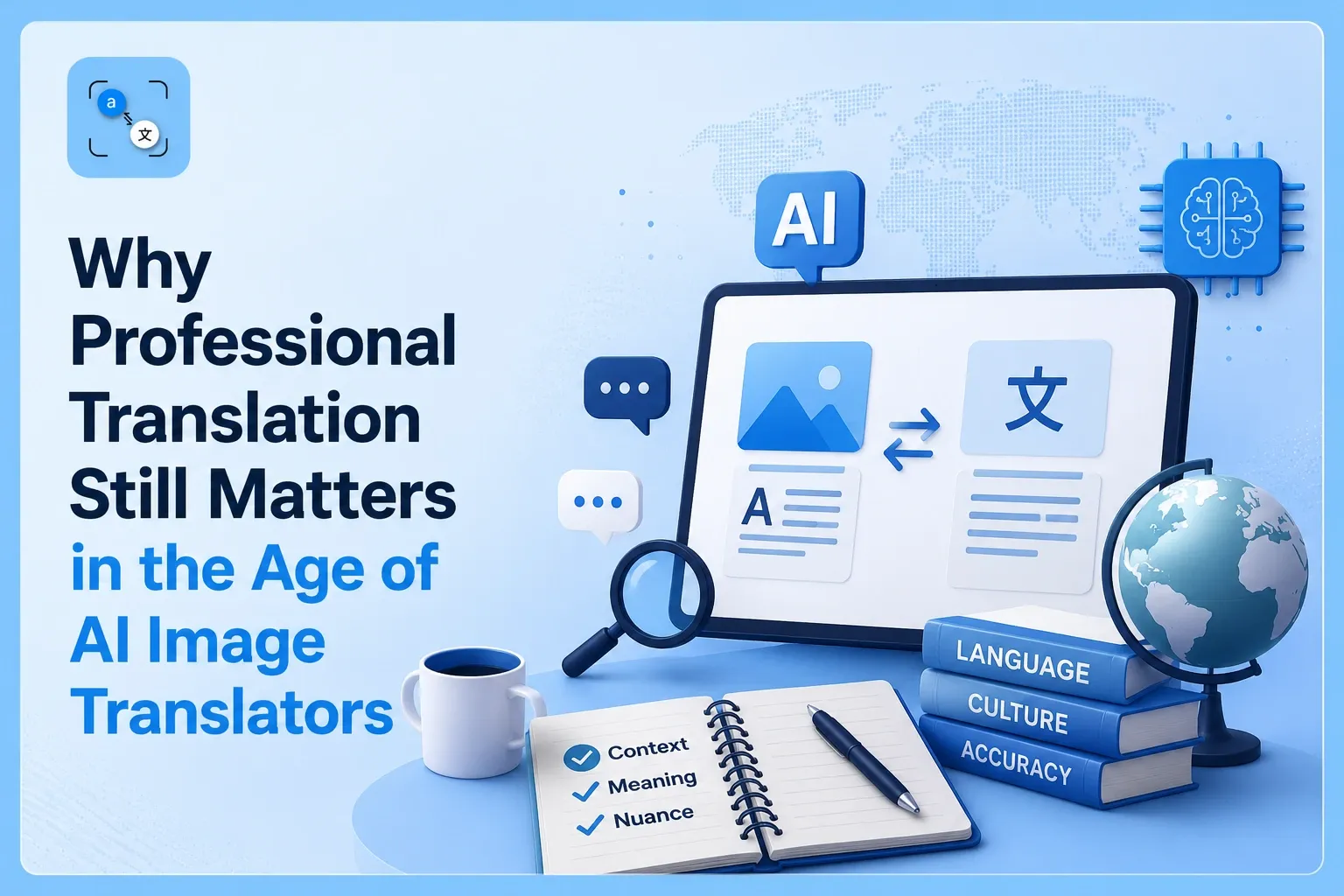
Pointez l'appareil photo de votre téléphone sur un menu à Osaka. Les mots se traduisent instantanément en anglais avant l'ouverture de l'obturateur de votre appareil photo. Il y a dix ans, cela aurait semblé magique. Aujourd'hui, les touristes y pensent à peine à deux fois avant de l'utiliser. Cette commodité peut rendre tentant de supposer que le même outil convient à un catalogue de produits, à une interface de jeu ou à une étiquette médicale. Mais ces cas d'utilisation comportent des exigences et des risques très différents. That's where the difference between casual translation and professional translation services becomes important. Business content needs more than a quick machine-generated result.
Ce que font réellement les traducteurs d'images
Un traducteur d'images IA combine généralement deux technologies. La première technologie est la reconnaissance optique de caractères, qui extrait le texte d'une image. Le second est le processus de traduction lui-même, qui fournit le texte dans une langue cible.
Des outils tels que Photo Translator fonctionnent plus ou moins sur le même principe. Il vous suffit de télécharger votre photo, d'extraire ses informations textuelles dans la couche OCR et d'attendre qu'elle soit instantanément traduite dans la langue cible. La politique de confidentialité stipule qu'aucune image n'est stockée au-delà de la durée du processus.
While OCR can recognize the word ‘rare,’ it cannot understand the contextual meaning of that word. A translation tool should be able to tell the different uses of this word in different contexts. The engine faces similar challenges when there is not enough context given for it to work with. It may not know that a “Continue” button needs a shorter or differently structured translation to fit the available space in Thai. These programs are impressively efficient at deciphering very short texts, but without enough context, it can be challenging to consider tone, audience, and consequences.
Le coût si cela est mal fait
HSBC's global slogan, "Assume Nothing," became "Do Nothing" in several markets. That single mistake undermined the entire campaign. The bank spent roughly $10 million on a rebrand to fix it.
That case happened before AI translation existed. But the root problem is still around today. Automated tools cause the same mistake, just faster and at a bigger scale: a phrase translated word for word, with no thought for what it needed to say.
Le risque financier se manifeste également auprès des consommateurs. RWS a interrogé plus de 6 500 personnes dans le monde en 2023. Plus de quatre personnes sur cinq ont déclaré qu'elles n'achèteraient pas auprès d'une marque qui ignore leur langue locale. Ce n'est pas un petit détail enfoui dans un guide de style. Il décide si un client s'engage avec le produit.
Different Industries, Different Risks
Risk changes by sector. E-commerce brands lose sales when product copy sounds stiff. Shoppers rarely complain; they just click away. Software companies face a harder problem: context-free translations can break layouts, mislabel features, or create inconsistencies between UI text and help content. Medical and technical companies carry much higher risks. A wrong dosage instruction or safety warning isn't a branding mistake. It can create serious compliance risks.
Gaming stands apart from all of this. Localizing a game is more than swapping dialogue into another language. It means adapting jokes, character voice, and lore across hundreds of thousands of words, often before the game is even finished. Translation strings often arrive without the surrounding scene, character context, or gameplay information they depend on. That's exactly the context an automated tool can't reconstruct on its own.
Player reviews make this clear pretty quickly. Players in non-English markets point out awkward localization within days of a game’s launch, and that feedback can influence sales for months.
Where AI Genuinely Helps
Automated tools designed for rapid and simple use are appropriate. A free photo translator that recognizes road signs, menus, or receipts in another language offers a valuable service that takes little time and presents minimal risk, as it does not require a commitment or payment of any kind. By contrast, translating a product catalog, legal document, or safety warning requires greater attention to terminology and consequences.
Good AI optimized translation services allow you to expedite certain segments of your project, such as first drafts, terminology checks, repeated UI strings, and other high-volume content where automation can safely accelerate the workflow. Machine translation post-editing (MTPE) involves a human linguist reviewing and refining machine translation rather than translating the content from scratch. This saves time and effort while still providing the quality assurance needed in critical segments.
The critical factor is not whether it’s AI versus human. For certain content types, fast automated processing is appropriate. Meanwhile, more sensitive content types call for careful, professional-level attention to the target language and potential risks in case of an error. An informal blog post may require little oversight compared with a legal disclaimer, medical instruction, or safety warning. But a legal disclaimer, game intro, and warning sign require a much higher level of review.
Questions to Ask Before Choosing a Workflow
A few questions can help determine whether AI translation is appropriate or human review is necessary:
- Does this content carry legal, safety, or brand risk if it's wrong?
- Will native speakers read this as a finished product, or just for information?
- Does the layout depend on text staying within a set length?
- Is a native-speaking reviewer part of the process before publishing?
The right answer depends on whether an AI-only pass is enough or whether a linguist needs to review the output. Skipping that step is how localization budgets get spent twice: once on the automated translation and again on the fix after launch.
The companies with the best results aren't avoiding automation. They aren't relying on it blindly. They're building a workflow where AI-optimized translation services handle volume and speed. Linguists then handle brand voice, legal terminology, and the contextual decisions automation cannot reliably make. That mix is what lets a product scale into new markets without leaving behind broken interfaces or costly localization fixes.