
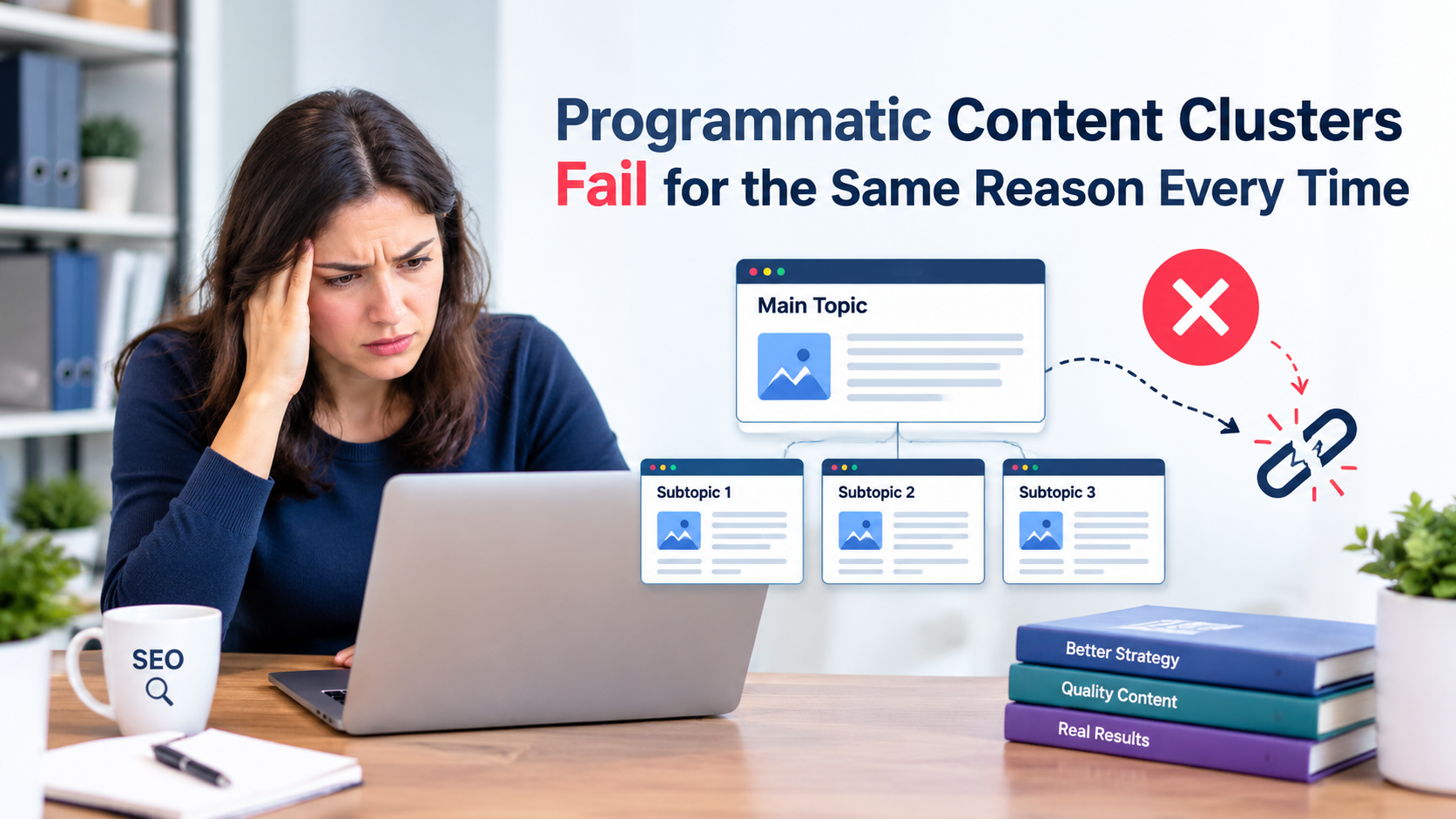
Programmatic content clusters look like a reliable way to scale content. You group your keywords, plan your topics, and publish dozens of pages in a single sprint.
But when most of those pages never earn a ranking, it's usually because nobody stopped to make editorial decisions first. Google treats pages without a distinct angle like filler, so your organic traffic stays flat even after all that effort.
We've seen this play out across every programmatic SEO project our team at SEO Sandwich has been asked to fix. This article breaks down the root cause behind that failure and the editorial thinking you'll need to avoid it.
Keyword Research Without a Content Strategy

A keyword list grouped into clusters looks like progress. But it isn't a content strategy until someone decides what each page should say that the others don't.
That gap shows up constantly in the clusters we're asked to fix. The team ran keyword research, built a cluster map with pillar pages and related subtopics, and stopped there. What they skipped was mapping keywords to relevant pages with a specific angle for each one.
And the result plays out the same way every time. When multiple pages on your site target the same user intent with no editorial differentiation, search engines won’t be able to tell them apart. Google picks none of them, and the whole topic cluster cannibalises itself. And pages that could have ranked for secondary keywords end up competing with each other, while your real content gaps go untouched.
Once keyword research is done, most teams hand the list straight to their AI tools. That's where the next problem starts.
Bad Cluster Topics Waste AI-Generated Content

Most teams blame the AI output when the real problem started before a single word was written. AI-generated content will scale whatever you feed it, including briefs where one page covers the same ground as the next (every single time).
And that scaling exposes a gap between the topic list and the writing brief, where most programmatic SEO projects lose quality:
-
No Editorial Filter on Topics: Editors rarely check whether cluster topics overlap before briefs go out, so AI-generated text fills pages that should never have existed. When your intended audience hits five URLs with no distinct angle, they will bounce.
-
Identical Prompts, Identical Output: Fifty prompts built from the same data with no unique angle per page will produce fifty near-identical results at high volume. If the inputs don’t vary, the output won't either.
-
No Checkpoint Between Research and Publishing: Most content production processes jump from keyword research to publishing without a single editorial review. Frankly, the AI isn't the problem here. The process is missing human judgment between the topic list and the first draft.
Matching content to search intent before writing starts is the only way to give each cluster page a reason to exist. Drop that step, and your programmatic content will read like one long page split into dozens of hollow copies.
Content Production Without Internal Links
Publishing 30 cluster pages in a week means nothing if none of them links to each other. Since content production workflows focus on getting pages live, teams batch-publish and move straight to the next brief.
The clusters we've rebuilt tell the same story: orphaned cluster pages sitting disconnected from pillar pages, supporting articles, and existing pages with no plan connecting them. Google Search Console might show those pages as indexed, but search engines won't pass authority between pages that have no relevant internal links.
Your topic cluster loses its structure when that happens, and organic traffic from those pages stays close to zero. Supporting content and supporting articles only build value when someone connects them to the rest of the site through internal links.
That's an editorial call, and it needs to happen before you publish.
AI Content Detection Won't Fix Editorial Quality
Running every page through an AI detection tool gives teams a false sense of safety (not even close). A clean score may confirm the writing doesn't flag as AI-generated text, but it says nothing about whether Google will rank that page.
Most teams then move on to on-page SEO signals like schema markup and structured data. Those are worth getting right, but they won't compensate for thin content aimed at no specific audience. Google rewards pages that answer common questions with depth, cite credible sources, and match the user intent behind the search. Yet, that's the part most teams skip over entirely.
In practice, a page that passes AI content detection but targets no clear reader need will lose search visibility over time. Whereas a page with genuine editorial quality, one that adds context and gives readers a concrete reason to stay, will hold its search rankings.
The difference has nothing to do with whether your article came from a person or a machine. Quality content written for your intended audience is what earns a spot in search results.
You can track this visibility drop in Google Analytics and monitor your search results over time. But no amount of data or strategy will fix a programmatic SEO cluster where the editors never made quality the priority from the start.
Build Authority by Publishing the Best Content
Every section of this article traces back to one root cause: programmatic content clusters fail when no one makes editorial decisions before publishing. Writing fewer, better pages with a content strategy behind each one is the only reliable way to fix that.
Google rewards sites that build authority through depth. AI overviews, traditional search, and answer engines all pull from the same pool: pages with genuine topical authority. All three favour depth over volume. And an editor who gives each page a clear path, a specific audience, and a reason to exist is doing the work that earns search rankings.
If you want to scale your core clusters without losing quality, add an editorial checklist to your content marketing workflow. Treat every page like it needs to earn its own organic traffic. SEO Sandwich builds content programmes with that editorial layer baked in from day one.