
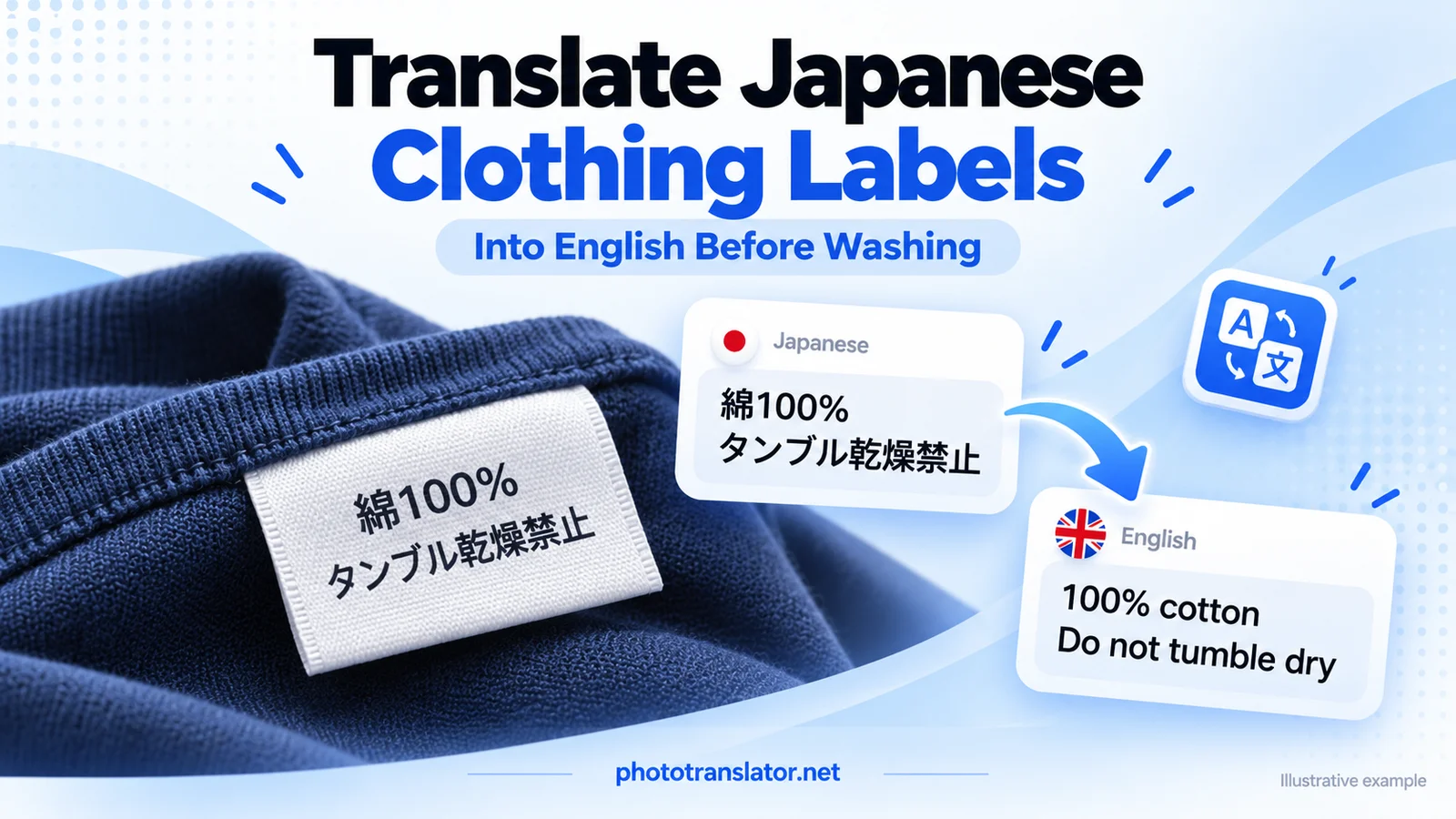
To translate Japanese clothing labels, take a clear photo of both sides of the care tag, upload it to a photo translator, and select Japanese to English. Read the translated warnings, then check the laundry symbols separately. If either is unclear, confirm with the manufacturer or a professional cleaner before washing.
A second-hand jacket or an imported shirt can arrive with a tag you cannot read. The useful information is usually there; you just need to separate the fabric details from the washing instructions.
Find the care label, not just the brand tag
Look inside the garment, including the side seams and collar area. Unfold every attached label and check the reverse.
You are looking for three things:
- Fabric composition: materials and percentages, such as 綿100% (100% cotton).
- Laundry symbols: instructions about washing, bleaching, drying, ironing and professional cleaning.
- Written warnings: extra directions about detergent, laundry nets, colour transfer or drying.
Do not stop at the fabric name. “100% cotton” tells you the material; it does not tell you whether the finished garment can be tumble dried.
How to translate a Japanese clothing label from a photo
1. Photograph the whole tag clearly
Lay the label flat against a contrasting surface. Use soft daylight, keep your phone parallel to the tag, and tap the text to focus.
Take one photo of the complete label, then a close-up of any small writing. Photograph both sides. Keep the full sentence visible rather than cropping individual words.
2. Upload the image and choose Japanese to English
Open Photo Translator, choose your label photo, select Japanese as the source language and English as the target, then click Translate. The tool accepts PNG, JPG, and WebP images.
Check the displayed translation alongside your original photo. Save the translated text or image if you want a reference for the next wash.
The text-reading stage uses optical character recognition. Our short guide to what OCR technology does explains the process without technical jargon.
3. Review warnings before choosing a wash cycle
Look for restrictions first: do not wash, do not bleach, do not tumble dry, wash separately, or use a laundry net.
Check that numbers, percentages, and negative words have been preserved. A missing “not” can reverse an instruction. If a sentence looks incomplete or strange, retake the photo instead of guessing what it means.
4. Check the symbols separately
A clothing label translator helps with written Japanese. Do not assume it has correctly interpreted every pictogram.
Compare the symbols with Japan’s official care-label guide. Use the complete label, not one translated line, to decide how the garment should be cleaned.
Common Japanese care-label words in English
Use this table to recognise common instructions. These are individual phrases, not a complete care recommendation for any particular garment.
| Japanese text | English meaning |
| 手洗い | Hand wash |
| 洗濯ネット使用 | Use a laundry net |
| 中性洗剤使用 | Use a neutral detergent |
| 漂白禁止 | Do not bleach |
| タンブル乾燥禁止 | Do not tumble dry |
| 平干し | Dry flat |
| 陰干し | Dry in the shade |
| あて布使用 | Use a pressing cloth |
| 単独洗い | Wash separately |
| 絞らないでください | Do not wring |
Wording varies between brands. For examples of supplementary instructions used on actual products, see UNIQLO’s care-label explanation.
You may also see 綿 (cotton), 絹 (silk), ポリエステル (polyester) or ナイロン (nylon). Keep their percentages attached to the correct material when reviewing a translation.
A simple example
Suppose a label says:
綿100% / 洗濯ネット使用 / タンブル乾燥禁止
This means:
100% cotton / Use a laundry net / Do not tumble dry.
It does not specify the washing temperature or whether machine washing is allowed. You still need the washing symbol and any remaining instructions. This is an illustrative phrase example, not output from a live tool test.
What do Japanese laundry symbols mean?
Start with the five basic shapes:
- Washtub: washing.
- Triangle: bleaching.
- Square: drying.
- Iron: ironing.
- Circle: professional cleaning.
The details change the meaning. A cross prohibits the indicated process; bars below certain symbols indicate gentler treatment. A number inside a washtub gives the maximum washing temperature in Celsius not a temperature you must reach.
Vintage garments need extra care when choosing a reference chart. Japan used an older symbol system before December 2016, and revised its newer system again in August 2024. The Consumer Affairs Agency’s laundry-symbol page links to the relevant versions.
Avoid using a random older chart to assign exact heat settings to every label.
What if the translation looks wrong?
Try these checks before washing:
- Tiny or blurred text: move closer and refocus; avoid heavy digital zoom.
- Folded tag: flatten it gently and photograph each side separately.
- Missing sentence: include the whole line, especially its ending.
- Mixed materials: confirm each percentage belongs to the right fabric.
- Faded printing: ask the brand or a cleaner if a fresh photo still cannot recover the instruction.
If the text and symbols appear to disagree, pause. Do not choose whichever interpretation is more convenient.
For a separate shopping problem, our Shein size-chart translation guide covers sizing rather than garment care.
Frequently asked questions
Can I translate Japanese clothing labels without typing?
Yes. Upload a clear photo to an image translation tool and choose Japanese to English. Review the result against the original tag, especially restrictions and numbers.
Does a crossed-out wash tub mean “hand wash only”?
No. It means the garment must not be washed in water at home, including by hand. Check the professional-cleaning instructions instead.
What does 洗濯ネット使用 mean?
It means “use a laundry net.” This is an additional instruction, not permission to use any washing cycle or temperature.
Can a photo translator read laundry symbols?
Do not rely on text translation alone for symbols. Check them against an authoritative chart and confirm that the chart matches the label system.
What should I do if the care label is unreadable?
Check the brand’s care information or contact its support team with the garment’s product details. For valuable or delicate clothing, ask a professional cleaner before washing.
Before washing: translate the writing, verify the symbols, and resolve any uncertainty. A readable English translation helps only if it preserves the garment’s actual instructions.