
Internationale Gäste kommen schon lange vor ihrer Ankunft an der Rezeption mit den Inhalten des Hotels in Kontakt.
Vor der Buchung lesen sie möglicherweise Zimmerbeschreibungen, vergleichen Preise, sehen sich Speisekarten an, informieren sich über den Flughafentransfer und prüfen die Hotelrichtlinien. Nach ihrer Ankunft orientieren sie sich möglicherweise auch anhand von Schildern, gedruckten Anweisungen, Speisekarten und anderen Gästeinformationen.
Wenn dieser Inhalt schlecht übersetzt wird, kann schon ein kleiner Formulierungsfehler zu Verwirrung führen.
Das Problem ist nicht immer eine falsche Grammatik. Manchmal ist die Übersetzung zwar technisch korrekt, klingt aber unnatürlich, hat den falschen Ton getroffen oder vermittelt einem Gast aus einer anderen Kultur etwas nicht klar genug.
Dank der Technologie ist das schnelle Übersetzen heute viel einfacher geworden. Reisende können nun Texte aus Bildern übersetzen, wenn sie auf Speisekarten, Schilder oder gedruckte Informationen in einer anderen Sprache stoßen.
Hotels, however, have a different responsibility. Their official guest-facing content needs to be accurate, natural and consistent.
Bei wichtigen Marketing- und Markeninhalten können Unternehmen auch mit einer weltweit tätigen Transkreationsagentur zusammenarbeiten, die versteht, wie Sprache, Kultur und Markenstimme zusammenwirken.
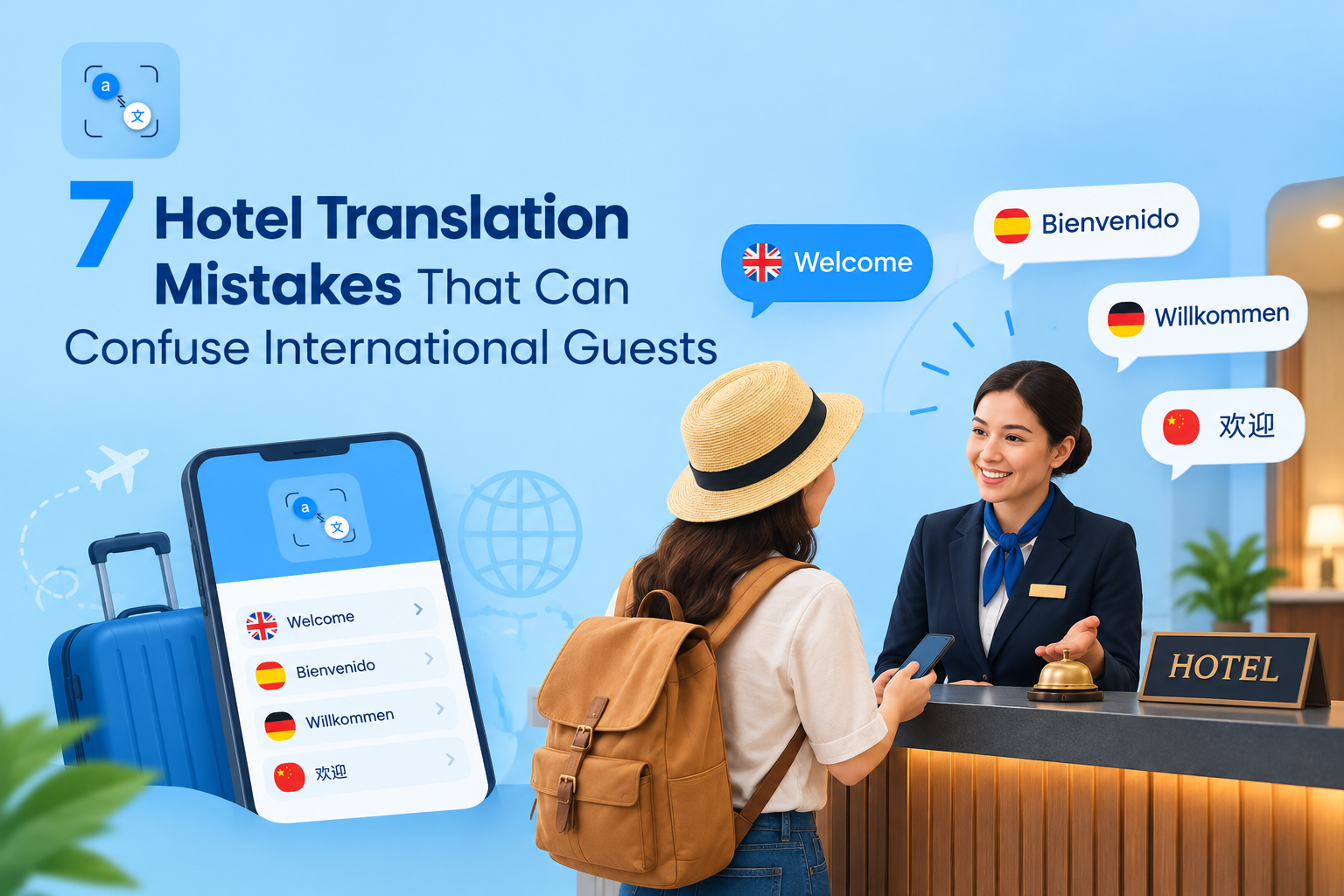
Here are seven hotel translation mistakes that can create problems for international guests.
1. Alles Wort für Wort übersetzen
Die wörtliche Übersetzung ist einer der häufigsten Fehler bei Hotelübersetzungen.
Das passiert, wenn der Übersetzer sich zu sehr an den Originalsatz hält, anstatt sich zu fragen, wie ein Muttersprachler denselben Gedanken auf natürliche Weise ausdrücken würde.
Betrachten Sie diesen Satz:
„Lassen Sie sich von der friedlichen Atmosphäre des Meeres umgeben.“
The meaning is understandable, but it does not sound like normal hotel copy in English.
A more natural version might be:
“Relax with peaceful ocean views.”
Both sentences communicate a similar idea, but the second is easier to read.
Das ist wichtig, weil Hotelinhalte oft mehr leisten müssen, als nur Informationen zu vermitteln.
Eine Zimmerbeschreibung, ein Resort-Paket oder eine Wellness-Seite sollten das Erlebnis ebenfalls ansprechend darstellen.
Eine wörtliche Übersetzung mag bei einfachen Informationen wie Check-in-Zeiten oder grundlegenden Anweisungen funktionieren. Sie ist jedoch weniger zuverlässig, wenn der Originaltext Emotionen, Humor oder eine bildhafte Sprache enthält.
Hotels sollten daher vor Beginn der Übersetzung sachliche Inhalte von Marketinginhalten trennen.
2. Using Strange Words on Restaurant Menus
Speisekarten von Hotelrestaurants sind besonders schwer gut zu übersetzen.
Food names, ingredients and cooking methods do not always have direct equivalents in another language.
Eine wörtliche Übersetzung kann ein verlockendes Gericht in etwas verwandeln, das seltsam klingt.
Imagine reading:
„Mit Feuer gegartes Rindfleisch mit schwarzer Soße.“
The guest can probably guess what it means.
Aber:
“Chargrilled beef with black pepper sauce.”
is much clearer and more appetising.
Bei traditionellen Gerichten wird das Problem noch komplizierter.
Names such as sushi, dim sum, tacos or nasi lemak usually do not need to be replaced with completely different English names.
Stattdessen können Hotels den bekannten Namen des Gerichts beibehalten und bei Bedarf eine kurze Erklärung hinzufügen.
Zum Beispiel:
Nasi lemak — Coconut rice served with sambal, anchovies, peanuts and egg.
Travellers who encounter an unfamiliar printed menu can also use photo translation tools to understand basic text quickly.
But the official hotel menu should already be written clearly enough that guests do not have to guess what they are ordering.
Menu translation also needs special care around allergies and dietary requirements. Information about nuts, dairy, gluten or other ingredients should always be clear rather than creative.
3. Translating the Website but Not the Booking Process
Ein weiterer häufiger Fehler tritt auf, wenn ein Hotel seine Website übersetzen lässt, dabei aber die Buchungsmaschine außer Acht lässt.
The guest reads the homepage in their preferred language.
They explore the rooms.
Sie finden ein Paket, das ihnen gefällt.
Then they click Book Now and suddenly everything appears in another language.
This creates unnecessary friction at the most important stage of the customer journey.
Bei einem umfassenden Lokalisierungsprojekt für ein Hotel sollten auch die Informationen berücksichtigt werden, die den Gästen bei der Buchung angezeigt werden.
This includes room names, rates, taxes, date formats, payment instructions, cancellation rules and confirmation messages.
Selbst kleine Details sind wichtig.
For example, dates can easily create confusion between markets.
05/07/2026 could mean May 7 in one country and July 5 in another.
Currency should also be clearly identified, especially when international visitors are comparing rates.
The goal is simple: guests should not have to work harder to complete a booking just because they speak another language.
4. Making Guest Communication Too Formal
Professional does not always mean formal.
Some hotel translations use long, complicated sentences because the translator is trying to sound polite.
Das Ergebnis kann sich unnatürlich anfühlen.
For example:
“We kindly request our esteemed guests to communicate with the reception counter should any additional assistance be required.”
A hotel could simply say:
“If you need any help, please contact reception.”
The second version is easier to understand while still being polite.
This is especially important for international guests who may understand the target language but not speak it fluently.
Clear language makes communication easier.
Hotels should normally keep guest instructions:
Marketing content can be more expressive, but operational information should usually stay simple.
Guests should never have to reread a sentence three times to understand when breakfast ends or where they need to check out.
5. Ignoring Cultural Differences
A grammatically correct translation can still send the wrong message.
Different cultures may have different expectations around privacy, service, luxury, family travel, dining and communication.
Consider a resort trying to promote privacy with this sentence:
“Enjoy complete isolation from everyone around you.”
The hotel may intend to describe a peaceful private experience.
However, the word “isolation” can sound negative.
A more natural version might be:
“Enjoy complete privacy in a secluded setting.”
The basic message is similar, but the feeling is different.
The same issue appears with humour, idioms and advertising slogans.
A phrase that works well in one country may make little sense when translated directly into another language.
This is why localisation is different from simple translation.
Localisation considers how the message will be understood by people in the target market.
That may involve changing vocabulary, tone, cultural references, examples or even the sentence structure.
The hotel still communicates the same overall idea, but it does so in a way that feels natural to the new audience.
6. Losing the Hotel's Brand Voice
A luxury hotel, family resort and budget airport hotel should not all sound the same.
Each property has its own personality.
One hotel may use warm, conversational language.
Another may be elegant and understated.
A resort might focus on relaxation and nature, while an urban hotel may focus on design, dining and nightlife.
Poor translation can remove these differences.
A distinctive English description might become:
“Our hotel offers luxury rooms and excellent service.”
The sentence is not incorrect.
The problem is that almost any hotel could say it.
Good hospitality translation should protect the hotel's tone as well as the meaning.
This is where specialist hotel and hospitality translation services can be useful. Hospitality content often covers websites, booking journeys, menus, campaigns and other guest touchpoints, and each needs the right balance between accuracy and natural language. IPPWORLD specifically positions its hotel work around native-language editing and transcreation for hospitality brands.
Hotels can also create a simple language guide for translators.
It can define preferred room names, restaurant names, important brand terms, level of formality and words that should remain untranslated.
This helps the hotel sound like the same brand in every language.
7. Relying on Automatic Translation for Everything
Automatic translation has improved quickly.
It can be extremely useful for understanding basic information, translating a sign while travelling or getting the general meaning of an unfamiliar document.
That does not mean every hotel document should be published without human review.
The risk is highest when content includes:
A machine may understand what a sentence says without understanding how the hotel wants the guest to feel.
This distinction matters especially for marketing.
For example:
“Sleep above the clouds.”
A translation system might translate those words accurately.
But if the expression sounds strange in the target language, a human editor may need to rewrite it while keeping the original idea.
There is a useful difference between translating something so you can understand it and translating something so a business can publish it professionally.
Photo Translator has also explored why professional translation still matters, particularly when accuracy, context, or business risk is important.
Hotels can still use technology to speed up translation workflows, but important guest-facing material should receive the level of review it deserves.
Hotel Translation Should Follow the Guest Journey
One useful way to improve hotel translation is to stop thinking about individual documents.
Instead, follow the guest.
Before booking, the traveller may interact with the hotel's website, advertisements, social media pages, room descriptions and destination guides.
During booking, they need clear information about rates, taxes, room types, payment and cancellation.
Before arrival, the hotel may send check-in information, transfer instructions and restaurant recommendations.
During the stay, guests may read menus, signs, spa information, room instructions and hotel directories.
After departure, they may receive a feedback request or loyalty offer.
If some of these touchpoints are translated well and others are not, the guest experience becomes inconsistent.
Hotels should therefore identify the languages used by their main international markets and decide which guest touchpoints need localisation first.
The most important content usually includes the website, booking process, policies, menus and essential guest information.
Translation, Localisation and Transcreation Are Different
These terms are often used together, but they do not mean exactly the same thing.
Translation focuses on communicating the correct meaning in another language.
This is often enough for simple factual information.
Localisation goes further by adapting the content for a specific market.
It can include currency, date formats, terminology, cultural references and other local expectations.
Transcreation is more creative.
It focuses on recreating the effect of marketing content rather than translating every word directly.
A hotel may need all three.
A cancellation policy may need accurate translation.
A booking page may require localisation.
A luxury advertising campaign may benefit from transcreation.
Choosing the right approach for each type of content can improve quality without making every translation project unnecessarily complicated.
How Hotels Can Check Translation Quality
Hotel teams do not need to speak every target language to improve quality control.
One useful step is to ask a native speaker from the intended market to read the finished translation without looking at the original.
Then ask simple questions.
Does anything sound strange?
Is anything difficult to understand?
Does the wording sound appropriate for a hotel?
Does the property still sound professional?
Would a local hotel normally use these expressions?
This can reveal problems that a basic grammar or spelling check may miss.
For important markets, hotels should also maintain approved terminology for recurring content such as room categories, facilities, restaurant names and loyalty programmes.
The aim is consistency.
A room should not have one translated name on the hotel website and a completely different name inside the booking system.
Final Thoughts
Hotel translation affects more than words.
It affects how easily international guests can understand the property, make a booking, and enjoy their stay.
The most common problems usually come from translating too literally, using unnatural menu language, ignoring the booking process, choosing the wrong tone, missing cultural differences, losing the brand voice, or relying too heavily on automatic translation.
Technology can make everyday translation much faster, particularly when travellers need to understand signs, menus or printed text.
Professional hotel content has a different goal.
It needs to be accurate enough to avoid confusion and natural enough to feel as though it was written for the guest in the first place.
When hotels get that balance right, translation becomes almost invisible.
Guests simply get the information they need, in language that makes sense to them.